| Version 14 (modified by , 4 years ago) ( diff ) |
|---|
Site Navigation
- COSMOS Testbed Overview
- Getting Started
- COSMOS/ORBIT User Guide
- COSMOS Portal
- Account Management
- Portal Dashboard
- Directory
- Disk Images
- Community Forum
- Getting Started with the COSMOS Portal
- SSH Access to Testbed Nodes
- Scheduler
- Testbed Status
- Installing Chrome Remote Desktop (CRD) on a Custom Image
- Tutorials
- Architecture
- Resources, Services and APIs
- Datasets
- Hardware Info
- RF Policies & Compliance
Amarisoft 4G/5G SDR System
Description
This tutorial contains instructions for running the amarisoft eNB and UE on various platforms.
Prerequisites
In order to access the test bed, create a reservation and have it approved by the reservation service. Access to the resources is granted after the reservation is confirmed. Please follow the process shown on the COSMOS getting started page to get started.
Resources required
2 servers, 2 USRP N310s or 2 USRP X310s on COSMOS SB1 or Weeks Hall domain
Tutorial Setup
Follow the steps below to gain access to the sandbox 1 console and set up nodes with appropriate images.
- If you don't have one already, sign up for a COSMOS account
- Create a resource reservation on sandbox 1
- Login into sandbox 1 console (console.sb1.cosmos-lab.org) with two SSH sessions.
- Make sure all the resources in the domain are turned off:
For this tutorial we will be using the SB1 servers, srv1-lg1, srv2-lg1 and USRP N310s, sdr1-md1, sdr1-s1-lg1
omf tell -a offh -t system:topo:allres
- Load amarisoft-tutorial-cosmos.ndz on srv1-lg1,srv2-lg1.
omf load -i amarisoft-tutorial-cosmos.ndz -t srv1-lg1,srv2-lg1
- Turn all the required resources on and check the status
omf tell -a on -t srv1-lg1,srv2-lg1,sdr1-md1,sdr1-s1-lg1
omf stat -t system:topo:allres
- ssh to the nodes, use option -Y for using GUI.
Tutorial Execution
- Upon logging into the nodes, run eth_config.sh script to setup the 10G data interfaces on the nodes, DATA1, DATA2. After running the script, you should see that the data interfaces have the appropriate IP addresses assigned, as per the table https://wiki.cosmos-lab.org/wiki/Architecture/Domains/cosmos_sb1#IPAddressAssignment
root@srv1-lg1:~# ./eth_config.sh
root@srv1-lg1:~# ifconfig DATA1
DATA1: flags=4163<UP,BROADCAST,RUNNING,MULTICAST>  mtu 9000
        inet 10.38.1.1  netmask 255.255.0.0  broadcast 10.38.255.255
        inet6 fe80::1e34:daff:fe42:c3c  prefixlen 64  scopeid 0x20<link>
        ether 1c:34:da:42:0c:3c  txqueuelen 1000  (Ethernet)
        RX packets 61195963  bytes 199994153268 (199.9 GB)
        RX errors 0  dropped 6680  overruns 0  frame 0
        TX packets 58734853  bytes 190912589303 (190.9 GB)
        TX errors 0  dropped 0 overruns 0  carrier 0  collisions 0

root@srv1-lg1:~# ifconfig DATA2
DATA2: flags=4163<UP,BROADCAST,RUNNING,MULTICAST>  mtu 9000
        inet 10.39.1.1  netmask 255.255.0.0  broadcast 10.39.255.255
        inet6 fe80::1e34:daff:fe42:c3d  prefixlen 64  scopeid 0x20<link>
        ether 1c:34:da:42:0c:3d  txqueuelen 1000  (Ethernet)
        RX packets 7378  bytes 651944 (651.9 KB)
        RX errors 0  dropped 6682  overruns 0  frame 0
        TX packets 282  bytes 82239 (82.2 KB)
        TX errors 0  dropped 0 overruns 0  carrier 0  collisions 0
- The nodes should now be able to access the USRP N310s sdr1-s1-lg1 and sdr1-md1
root@srv1-lg1:~# uhd_find_devices
[INFO] [UHD] linux; GNU C++ version 7.5.0; Boost_106501; UHD_3.15.0.0-release
--------------------------------------------------
-- UHD Device 0
--------------------------------------------------
Device Address:
    serial: 3176DF5
    addr: 10.38.2.1
    claimed: False
    mgmt_addr: 10.37.2.1
    mgmt_addr: 10.38.2.1
    mgmt_addr: 10.39.2.1
    product: n310
    type: n3xx


--------------------------------------------------
-- UHD Device 1
--------------------------------------------------
Device Address:
    serial: 3196937
    addr: 10.38.3.1
    claimed: False
    mgmt_addr: 10.37.3.1
    mgmt_addr: 10.38.3.1
    mgmt_addr: 10.39.3.1
    product: n310
    type: n3xx
MME
eNodeB/gNodeB
UE
Connecting Phones
Attachments (2)
- web_client_creation.png (6.8 KB ) - added by 4 years ago.
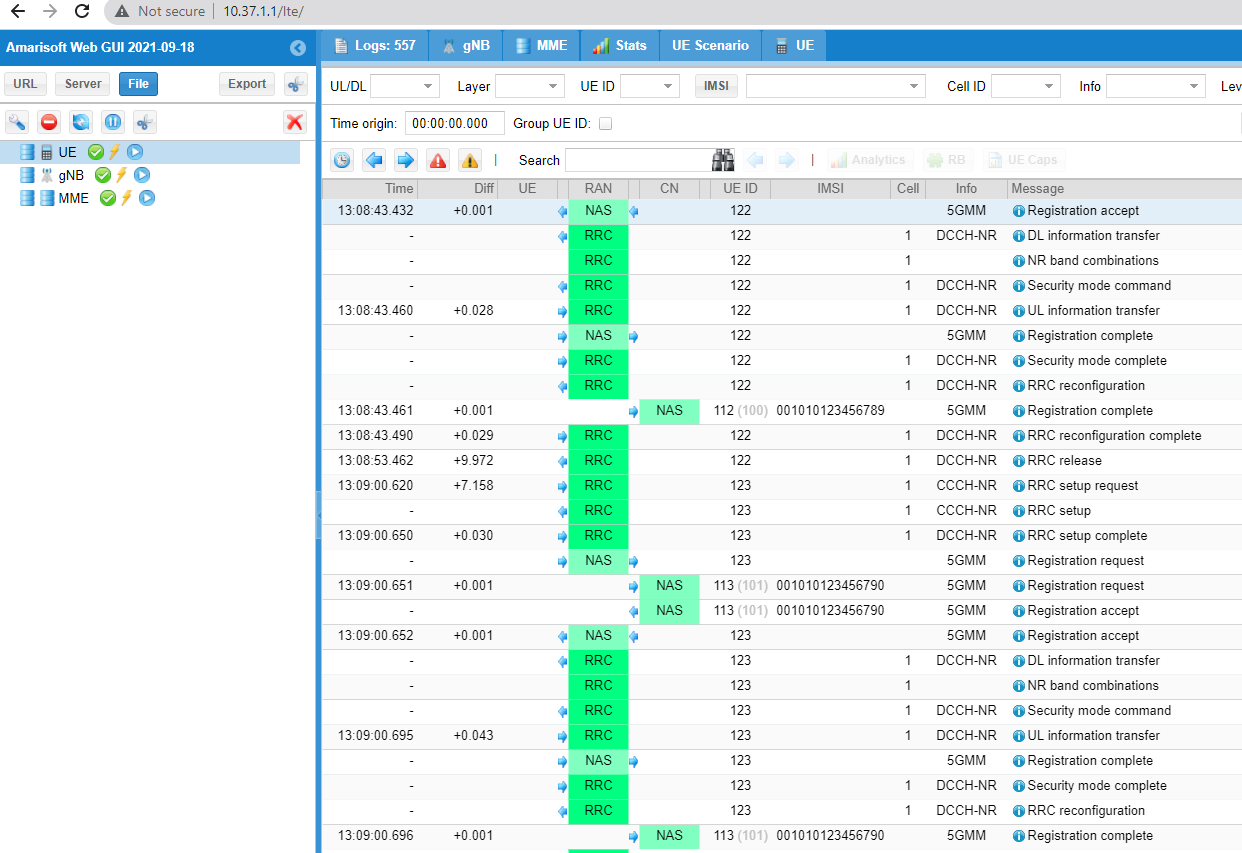
- amarisoft_web_interface.png (116.5 KB ) - added by 4 years ago.
Download all attachments as: .zip
Note:
See TracWiki
for help on using the wiki.